Organic vs Paid Traffic, Who Wins on ROI?
A 12-month look at how a $1,500/month budget performs across paid ads versus organic content — and why the right answer depends on your time horizon.
Most businesses default to paid ads because the math feels simple: spend money, get clicks, see traffic the same day. Organic content asks for patience before it pays you back. That patience is exactly what makes it the stronger long-term investment.
Evaluating organic versus paid traffic means comparing two fundamentally different growth curves — one instant and linear, the other slow to start and compounding. Here is what a $1,500/month investment ($50/day) looks like in each model across a full year.
Two Traffic Models, Two Different Curves
Paid ads run on a linear curve. Traffic is a utility: you pay a set fee per click, and the moment you stop paying, traffic drops to zero. Nothing is left behind — no asset, no library, no lasting presence.
Organic content runs on an exponential curve. Early months go almost entirely into building: content gets created and indexed, with little traffic to show for it in the first couple of months.. Once that content takes hold, however, it begins to compound. Each piece supports the next, authority builds on itself, and traffic continues growing without increasing your marketing budget.
Paid traffic is rented. Organic traffic is owned.
A 12-Month Cost & Traffic Breakdown
This baseline scenario assumes a steady $1,500/month investment in either approach, and is just for illustration purposes. Just as with paid advertising, organic traffic results may vary depending on a variety of conditions, as well as your competition. However, in our experience, this illustrates a very common scenario.
Paid Ads: Assumes an average $0.50 cost-per-click bringing a consistent 3,000 visitors every month, for as long as the budget keeps running.
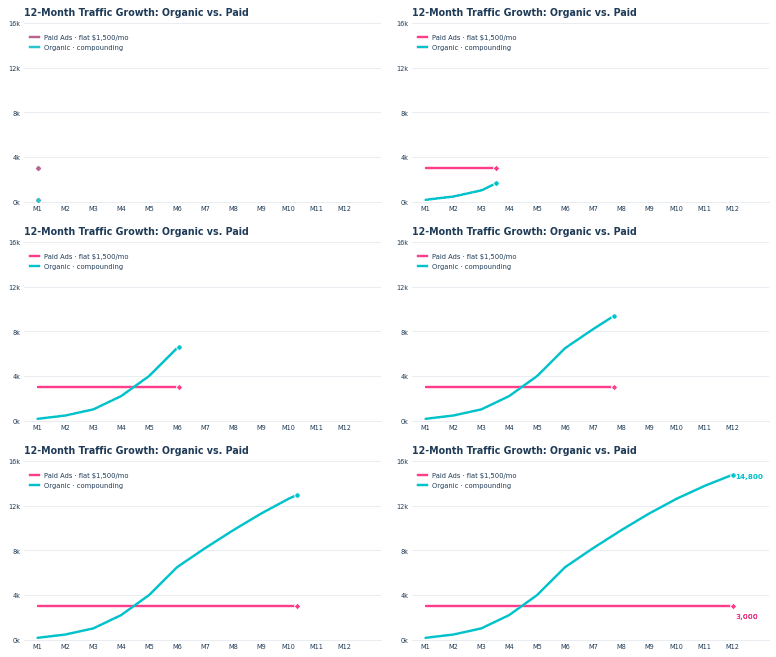
Organic Content Visibility Engine: the same $1,500/month goes into SEO-optimized content built around the buyer-intent questions your ideal customers are already asking. Traffic compounds as more content gets indexed and starts to rank. The chart below plots both curves side by side; the breakdown that follows shows the numbers month by month.

Paid vs. Organic Traffic: 12-Month Comparison
How organic traffic compounds over time vs. a flat paid spend of 3,000 visitors/month
| Month | ⚡ Paid Traffic | 🌱 Organic Traffic | Note |
|---|---|---|---|
| Month 1 | 3,000 | 150
|
Search engines indexing |
| Month 2 | 3,000 | 450
|
Early rankings appearing |
| Month 3 | 3,000 | 1,000
|
Authority building |
| Month 4 | 3,000 | 2,200
|
Content snowballing |
| Month 5 Crossover | 3,000 | 4,000
|
Surpassing paid traffic |
| Month 6 | 3,000 | 6,500
|
Peak early momentum |
| Month 7 | 3,000 | 8,200
|
Compounding continues |
| Month 8 | 3,000 | 9,800
|
Approaching content maturity |
| Month 9 | 3,000 | 11,300
|
Authority fully established |
| Month 10 | 3,000 | 12,650
|
Steady-state growth |
| Month 11 | 3,000 | 13,800
|
Long-tail keywords contributing |
| Month 12 | 3,000 | 14,800
|
Asset reaches first-year value |
| 12-Month Total | 36,000 | 84,850 | 2.36× more organic |
These figures are an illustrative model, not a guarantee — actual results vary by industry, competition, and content quality. The shape of the curve is what matters: slow start, then compounding return.
What the Numbers Mean in Dollars
By Month 6, the organic system is already producing 6,500 monthly visitors — more than double the paid-ad traffic from the same budget. Matching that volume through paid ads at $0.50 CPC would cost $3,250/month, more than double what is actually being spent.
By Month 12, the gap widens further. Organic traffic reaches roughly 14,800 visitors a month versus 3,000 for paid . Adifference that would cost about $7,400/month to replicate with ads. The same $1,500/month organic investment is now generating traffic worth nearly five times its cost, and the curve keeps climbing.
Why High-Intent Buyers Choose Organic First
Paid ads are good at catching impulse buyers, or people early in their journey. Organic content tends to catch buyers further along — the ones actively researching, comparing options, and asking specific questions before they decide. Buyers also tend to trust an organic answer more than a sponsored link, which is part of why organic traffic often converts at a higher rate.
The Disappearing Customer Acquisition Cost
With paid ads, customer acquisition cost is tied permanently to market ad rates, which climb every year. With organic, acquisition cost trends toward zero over time: content published in Month 2 keeps acquiring new visitors in Month 12 without any additional spend.
What to Expect Along the Way
Two things are worth planning for. The content runway: organic spending in Months 1 and 2 produces almost no return, and that gap needs to be financially comfortable before it closes. Maintenance decay: unlike paid traffic, organic traffic does not disappear the moment you stop, but it will erode slowly over 12 to 24 months if competitors publish better answers or search algorithms shift. Organic is a compounding asset, not a permanent one — it still needs upkeep.
The Bottom Line
Paid ads and organic content are not really competing for the same job. Paid buys speed. Organic builds an asset that keeps paying out long after the campaign ends. Most businesses that can afford to do both, should. But for a fixed monthly budget, the 12-month math increasingly favors organic.
Want to create an organic traffic Visibility Engine for your business? We will give you a visibility gap report, so you can see where you are now, and how we can help you.
g magcosta is the founder of PaperClick Marketing, a digital marketing company focused on helping businesses become more visible to their ideal buyers. She implements content-driven organic traffic visibility strategies, to help businesses increase trust, search visibility, and buyer engagement. Your answers. Everywhere your customers are looking.
Connect on LinkedIn
to talk business.